












How does human hearing work?
To understand all of this, let’s first dig into what humans can hear. It’s a bit more complicated than you might think.
The human ear is a complex organ that converts sound waves into signals that our brains can interpret. The ear consists of three parts:
- Outer ear: This is the part we can see. It captures sound waves and directs them to the eardrum.
- Middle ear: Here, three small bones (hammer, anvil, and stirrup) amplify the sound waves and transmit them to the inner ear.
- Inner ear: This part contains the cochlea, a fluid-filled structure that converts sound waves into electrical signals sent to the brain.
See? It’s not quite as simple as it seems.
Frequency range of humans
Human hearing has a frequency range of approximately 20 Hz to 20,000 Hz.
This means we can hear sounds within this spectrum, from the deep rumble of a bass to the high tones of a flute.
Within this range, we are more sensitive to certain frequencies than others.
This sensitivity helps us, for example, to distinguish human voices clearly in a noisy environment.
How does cat hearing work?
And now we turn to the hearing of our beloved cats. How does that actually work?
Cat ears have a unique shape and structure that gives them exceptionally good hearing.
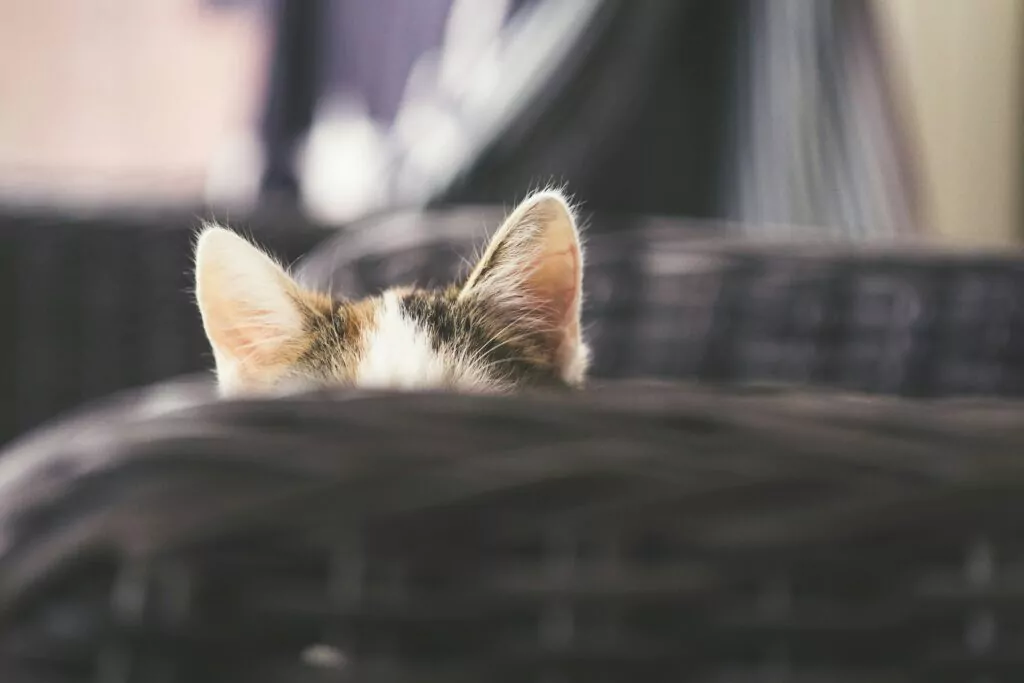
Their ears can rotate independently of each other, allowing them to pinpoint sounds accurately.
Cats have a frequency range of 48 Hz to as high as 85,000 Hz. This means they can hear both lower and much higher frequencies than humans.
As a result, they can perceive sounds that are inaudible to us, such as the squeak of a mouse. That’s also why your cat occasionally leaves a mouse on your porch ?
Cats can detect very small changes in pitch.
For example, they can hear the soft rustling of prey in the grass, even from a considerable distance.
So, there are often situations where you might wonder what your cat is hearing, while you hear nothing yourself.
Recent studies have shown that cats not only recognize speech directed specifically at them but can also localize complex sounds in a manner similar to humans (De Mouzon et al., 2022; University of Michigan, 2024) (ScienceDaily)
Comparison between cat and human hearing
Frequency range
A direct comparison of the audible range between cats and humans shows that cats are clearly superior. But we already knew that, right?
Humans are “limited” to 20 Hz to 20,000 Hz, while cats can perceive sounds from 48 Hz to 85,000 Hz.
Sound origin and direction
Cats are highly skilled at determining the direction of sounds, thanks to their ability to move their ears independently.
Humans can do this too, but not with the same precision and speed.
Adaptations and evolution
Cats have developed their hearing as part of their evolution as predators.
Their ability to hear high frequencies helps them detect small prey, while their precise directional sensitivity helps them locate sounds quickly.

Practical Applications and Interesting Facts
Cats in Daily Life
A cat’s exceptional hearing affects their behavior in many ways.
Cats are always alert, which means they often react to sounds we don’t even notice.
This can sometimes lead to amusing moments, such as when your cat suddenly starts staring at something in the middle of the room that you can’t hear, or rushes excitedly to their cat tree because they’ve picked up a faint sound that is inaudible to you.
Assistive devices for hearing-impaired people
Technologies have been developed that are inspired by cats’ hearing.
For instance, there are hearing aids that utilize frequency ranges and sensitivities similar to those of cats, to help people with hearing loss hear better.
Myths and misconceptions about cat hearing
There are many myths about cats’ hearing. A common misconception is that cats are deaf to low frequencies.
Although their hearing is more tuned to higher frequencies, cats can also perceive low sounds, though they are less sensitive to them than to higher pitches.
What makes cat hearing so special?
Cat hearing is incredibly advanced and differs from human hearing in many ways.
They have a broader frequency range, can localize sounds more accurately, and have a sensitivity to small pitch differences that makes them excellent hunters.
However, there are still many questions about cat senses that remain unanswered. What we do know helps us to better understand and appreciate our feline friends.
Whether you are a proud cat owner or just an animal lover, it’s fascinating to discover how unique these animals are in their perception of the world around them.
So, can cats hear better than humans? Yes, in a sense, because they pick up more signals and perceive sounds that are inaudible to us, such as very high frequencies and subtle pitch differences.
Find out how and why cats sleep the way they do
Disclaimer: Petrebels is not a veterinarian or behavior specialist: all content, information, and tips on this blog are intended to inspire and provide information. If your cat has health issues or problems and you are unsure about their well-being, always consult a veterinarian or a behavior specialist.