









Siberian cat or Norwegian Forest cat: which breed is the right match for you? Both have beautiful, thick coats, an impressive size and a friendly personality. However, there are some important differences in their appearance, behaviour and grooming needs.
Are you trying to decide between these two pedigree cats? Then it’s worth looking beyond their appearance. Although both resemble little forest dwellers, each breed has its own character and needs.
1. What is the difference between a Siberian cat and a Norwegian Forest cat?
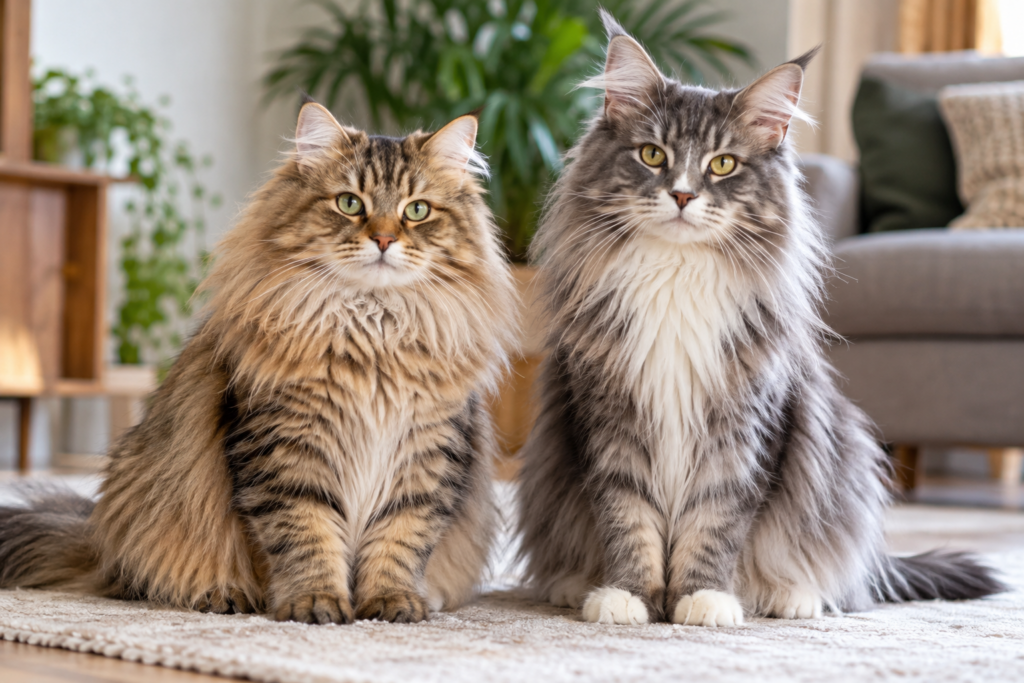
The main differences are their body shape, head shape and personality. Siberian cats are generally more compact, with a rounder appearance. Norwegian Forest cats have longer bodies, triangular heads and straighter nose profiles.
Their personalities also differ slightly. Both breeds are sociable, intelligent and playful. Siberian cats often actively seek interaction with their people. Norwegian Forest cats tend to be a little more independent, although they enjoy being part of family life just as much.
| Feature | Siberian cat | Norwegian Forest cat |
|---|---|---|
| Origin | Russia | Norway |
| Body shape | Strong, muscular and relatively rounded | Long, sturdy and athletic |
| Head shape | Rounded contours | Triangular with a straight profile |
| Coat | Dense, triple-layered coat | Semi-long coat with water-resistant guard hairs |
| Personality | Playful, sociable and curious | Friendly, calm and independent |
| Activity | Enjoys jumping, climbing and playing | Enjoys climbing and elevated places |
| Grooming | Regular brushing, especially during shedding season | Regular coat checks and brushing, especially during shedding season |
These characteristics describe general breed tendencies. Every cat has an individual personality. So a particularly calm Siberian or an exceptionally affectionate Norwegian Forest cat is certainly possible.
2. How can you recognise these two cat breeds?
The easiest way to distinguish these breeds is by looking at their heads and body shapes. Their thick coats can sometimes make the differences harder to notice at first glance.
The Siberian cat: strong and rounded
The Siberian cat has a powerful, muscular body with a broad chest and rounded features. Its head also appears relatively round, giving the breed a soft, friendly expression.
Its hind legs are slightly longer than its front legs, helping it perform impressive jumps. A high cupboard or shelf can quickly become an interesting challenge for an active Siberian Rebel.
The Norwegian Forest cat: long and athletic
The Norwegian Forest cat has a long, sturdy body and relatively tall legs. Its head has a distinctive triangular shape, with large ears that follow the lines of its face.
Its long, bushy tail and full neck ruff are also characteristic features. During winter, an adult Norwegian Forest cat can look even larger thanks to its particularly thick coat.
Both breeds develop slowly. It can take several years for their bodies and coats to reach full maturity.
3. Which personality is the best match for your family?
Both breeds are suitable for people who enjoy spending time with their cats. The main difference is how they seek attention and interact with their surroundings.
Siberian cats enjoy company
Siberian cats are known for their curious and sociable nature. They often enjoy following their people around the house and joining in with interactive games.
This intelligent breed learns quickly. Puzzle toys, hidden treats and interactive play sessions with a wand toy are all great ways to keep a Siberian entertained.
Many Siberian cats are affectionate without constantly demanding attention. They enjoy being nearby and prefer to decide for themselves when it’s time for a cuddle.
Norwegian Forest cats are friendly and independent
Norwegian Forest cats generally have a calm and balanced temperament. They enjoy spending time with their families but also appreciate having space to do their own thing.
Many Norwegian Forest cats prefer relaxing beside you rather than sitting on your lap all day. That doesn’t mean they’re less affectionate. They simply show their love in their own way.
These cats remain curious and playful. Climbing, observing their surroundings and gentle hunting games suit their natural instincts particularly well.
4. Which breed needs more grooming?
Both breeds need regular coat care. Siberian cats often require extra attention during shedding season because of their dense undercoat. Norwegian Forest cats have a different coat structure, but their fur can also develop tangles.
The Siberian has a thick, triple-layered coat that changes with the seasons. It becomes particularly full in winter, while much of the winter coat is shed during spring.
The Norwegian Forest cat has a dense undercoat with longer, water-resistant outer hairs. Its coat also changes throughout the year.
Here are some practical grooming tips:
- Brush your cat regularly and check for developing tangles.
- Pay extra attention to the armpits, chest, belly and hind legs.
- Increase grooming sessions when your cat is shedding heavily.
- Use a suitable comb and never pull forcefully on tangled fur.
- Introduce grooming gently while your cat is still young.
How often you need to brush your cat depends on its individual coat. Some cats only need a few grooming sessions each week. Others benefit from daily attention during shedding season.
Want to know which brush is suitable for your cat? Read our detailed guide to brushing your cat and caring for its coat.
5. How much exercise and space do these cats need?
Siberian cats and Norwegian Forest cats both need opportunities to move, explore and relax. Their size doesn’t automatically mean they need an enormous home. A well-designed environment and enough activities are just as important.
Both breeds love climbing and observing their surroundings. Safe, elevated resting places are therefore especially appealing. Interactive games also help encourage their natural hunting behaviour.
A suitable home should provide:
- Safe and sturdy climbing opportunities.
- Spacious resting areas where large cats can stretch out comfortably.
- Enough scratching surfaces for a full-body stretch.
- Toys that encourage movement and curiosity.
- Quiet places where your cat can retreat and relax.
Stability and sufficient space are particularly important for larger cats. A tiny platform isn’t much use when your cat can barely fit on it.
A sturdy cat tree with spacious platforms, strong sisal posts and accessible climbing levels is a practical choice. In our guide to choosing the right cat furniture, you’ll discover what to look for when selecting a suitable model.
6. What should you know about health and hereditary conditions?
For both breeds, it’s important to learn about hereditary conditions and responsible breeding. An impressive appearance doesn’t automatically mean a kitten is healthy.
In Siberian cats, hypertrophic cardiomyopathy (HCM) is one condition to be aware of. This heart disease causes the heart muscle to become abnormally thick.
For Norwegian Forest cats, both HCM and glycogen storage disease type IV (GSD IV) deserve attention. A DNA test is available for GSD IV. Ask a veterinary professional which health tests are appropriate for the breeding cats.
Always ask the breeder about the parents’ health history, relevant test results and the environment in which the kittens are raised. A responsible breeder should be happy to explain these details and introduce you to the cats and their surroundings.
For more information about breed characteristics and care, visit the official Norwegian Forest cat breed profile from The International Cat Association (TICA).
7. Siberian cat or Norwegian Forest cat: Which should you choose?
The best choice depends on your lifestyle and the personality of the individual cat. Breed characteristics are useful guidelines, but they cannot predict exactly how every cat will behave.
A Siberian cat is often a good match for someone who enjoys interactive play and spending plenty of time with their pet. This curious Rebel generally likes being involved in family activities.
A Norwegian Forest cat may suit you if you’re looking for a friendly, playful but usually slightly more independent companion. These cats enjoy being around their people while still appreciating their personal space.
If you’re still deciding between a Siberian cat or Norwegian Forest cat, pay attention to the individual animal’s personality. Ask about the kitten’s behaviour, meet the mother if possible and take your time deciding whether you’re a good match.
The most important points at a glance:
- Siberian cats generally have a rounder, more compact body.
- Norwegian Forest cats have longer bodies and triangular heads.
- Both breeds are sociable, intelligent and enjoy being active.
- Their thick coats need regular grooming.
- A safe, stimulating environment matters more than floor space alone.
8. Frequently asked questions about these cat breeds
Siberian cats are not guaranteed to be hypoallergenic. Some people may react less strongly to individual Siberians, but these cats still produce allergens. If you have a cat allergy, seek medical advice rather than relying on breed claims alone.
Both Siberian cats and Norwegian Forest cats can live indoors when their environment provides enough opportunities to move, climb, play and rest. A securely enclosed balcony or outdoor enclosure can offer additional stimulation.
Both breeds can live successfully with other cats. Their compatibility depends on individual personalities, available space and a gradual introduction. Provide enough separate feeding areas, litter boxes and resting places.
Both breeds can shed heavily, especially during seasonal changes. The amount of loose fur varies depending on the individual cat, coat condition and living environment. Regular brushing helps remove loose hair.
When choosing a Siberian or Norwegian Forest kitten, look for good socialisation, a clean and safe environment and healthy breeding cats. Ask for pedigree documentation, relevant health test results and clear information about vaccinations and care.
Choosing a Siberian cat or Norwegian Forest cat means welcoming a special companion with an individual personality. Take the time to get to know both breeds and understand what your future cat needs. Whether your Rebel prefers relaxing beside you on the sofa or watching the living room from the highest spot, every cat deserves a home where they can truly be themselves.
Disclaimer
Petrebels is not a veterinarian or animal behaviour specialist. All content, information and advice on this page is intended for general information and inspiration only. If your cat has symptoms or health problems and you are unsure what to do, always contact a veterinarian or qualified cat behaviour specialist.