










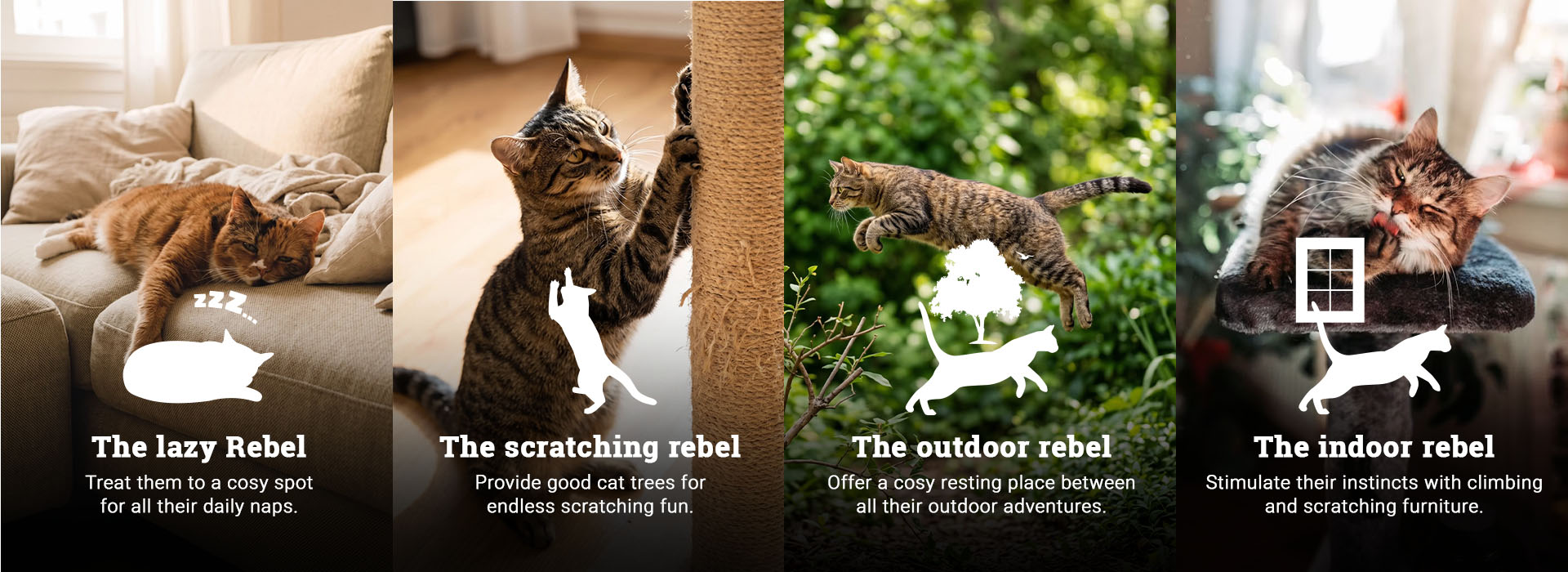
What kind of character is your Rebel?
No two cats are the same. One spends the whole day purring in the sun, another keeps a sharp eye from the top of the cupboard on everyone who walks in. And then there's the cat who decides at three in the morning that the hallway is a racetrack. Sound familiar? Then you live with a true Rebel.
At Petrebels, we believe every cat deserves a place that suits who they really are. That's why we don't just look at size or breed, but above all at character. Because a lazy rebel wants to lie soft, a scratching rebel needs to get those claws working, an indoor rebel wants to climb and explore, and an outdoor rebel wants to come home safely after every adventure.
On this page, we introduce you to four different characters: the lazy rebel, the scratching rebel, the indoor rebel and the outdoor rebel. How to recognise them, what they need to be happy and what to look for when choosing a scratching post.
Chances are you'll spot your cat straight away. Or in several characters at once, because yes, that happens too.
Which character suits your cat best? Find out below:
The lazy rebel: sleeping is a talent too.
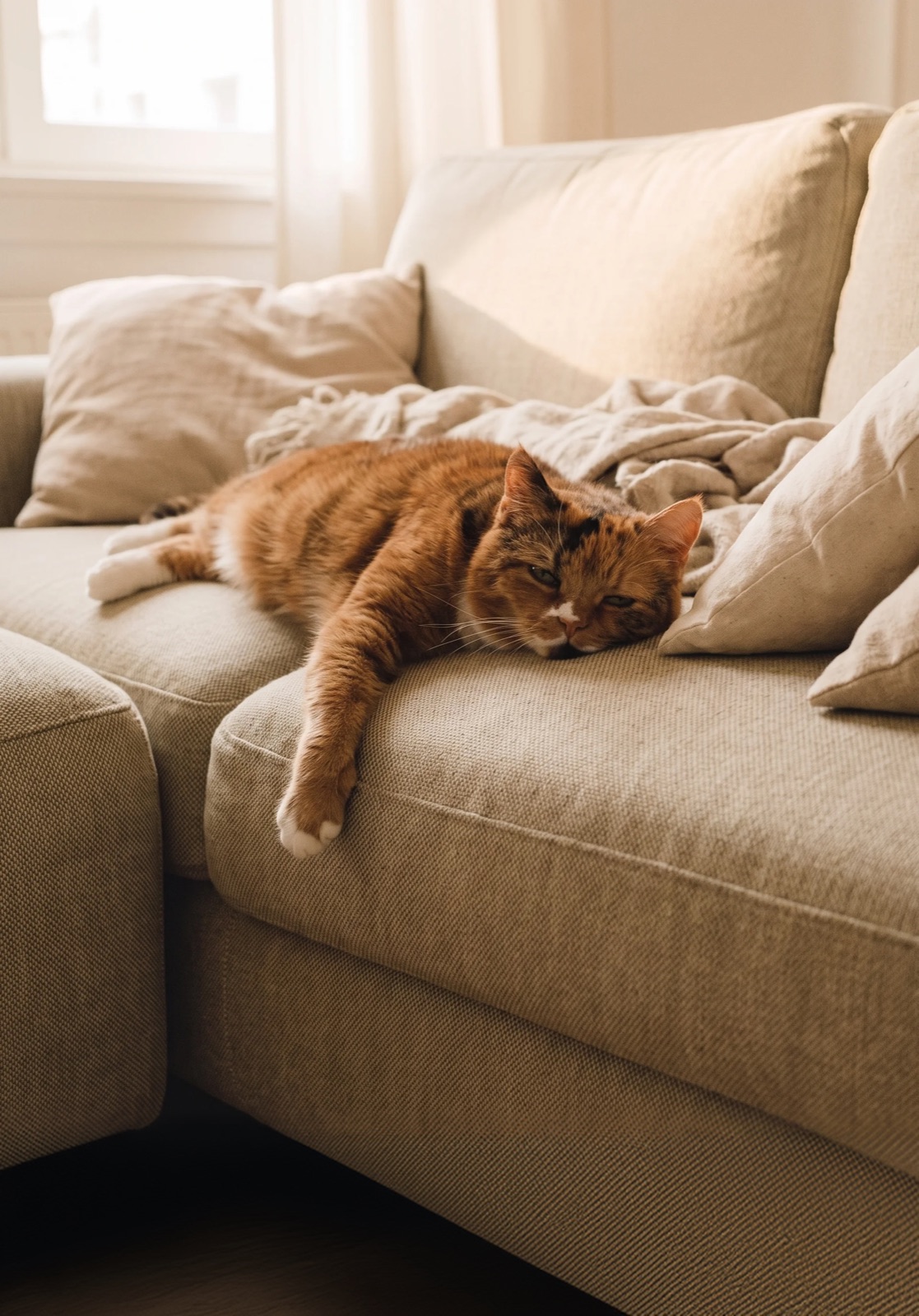
"Wake up? Maybe later. Or tomorrow."
The lazy rebel is the king of the catnap. While other cats run, climb and hunt, he picks the warmest spot in the house and stays there for as long as possible. Sixteen hours of sleep a day? For him, that's a quiet day. He's the bon vivant among the Rebels: no rush, no stress and always on the lookout for the next soft cushion.
But don't be fooled by those half-closed eyes. The lazy rebel knows exactly what he wants. He chooses his spot with care, ideally in the sun or right next to the radiator, and defends it with the nonchalance of a true Rebel. Sit down where he was just lying? You'll get a look that says more than a thousand meows.
How to recognise the lazy rebel
- He follows the sunlight around the room during the day.
- He has a few favourite sleeping spots and stays loyal to them.
- Visitors, vacuum cleaners and busy households barely bother him.
- He likes to play briefly, and preferably lying down: only his paw moves.
- After every nap he has a long, luxurious stretch, often followed by a quick scratch.
- A blanket or jumper that smells of you? He'll be lying on it within a minute.
What does the lazy rebel need?
Comfort, warmth and peace come first. A lazy rebel doesn't want to waste his energy on death-defying leaps to high platforms. Older or slightly heavier cats in particular appreciate a low step-up, as it's easier on their joints.
Still, a little exercise does him good. A lazy rebel who only sleeps can become stiff or overweight. So challenge him with short, calm play sessions: a feather slowly dragged across the floor, or a treat on a low platform that takes just one small step to reach. That keeps him supple without it ever feeling like work.
The ideal scratching post for the lazy rebel
- Large, roomy lying areas where he can stretch out completely.
- Extra-soft plush and thick cushions to sink into.
- A hammock or open basket for those truly lazy afternoons.
- A sturdy base, because even a lazy cat throws himself into bed with full commitment.
Rebel tip: place the lazy rebel's scratching post in his favourite sunny spot, for example by the window or near the radiator. He'll choose his new bed over your sofa in no time.
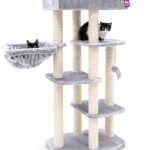
A quick stretch, a bite to eat and back to sleep. The lazy rebel doesn't like to make a fuss. And why would he, when he has a soft hammock or a cosy basket? Give this sleeping champion a great spot. The lazy rebel doesn't like to make a fuss. And why would he, when he has a soft hammock or a cosy basket? Give this sleeping champion a great spot
The scratching rebel: those claws have to go somewhere.
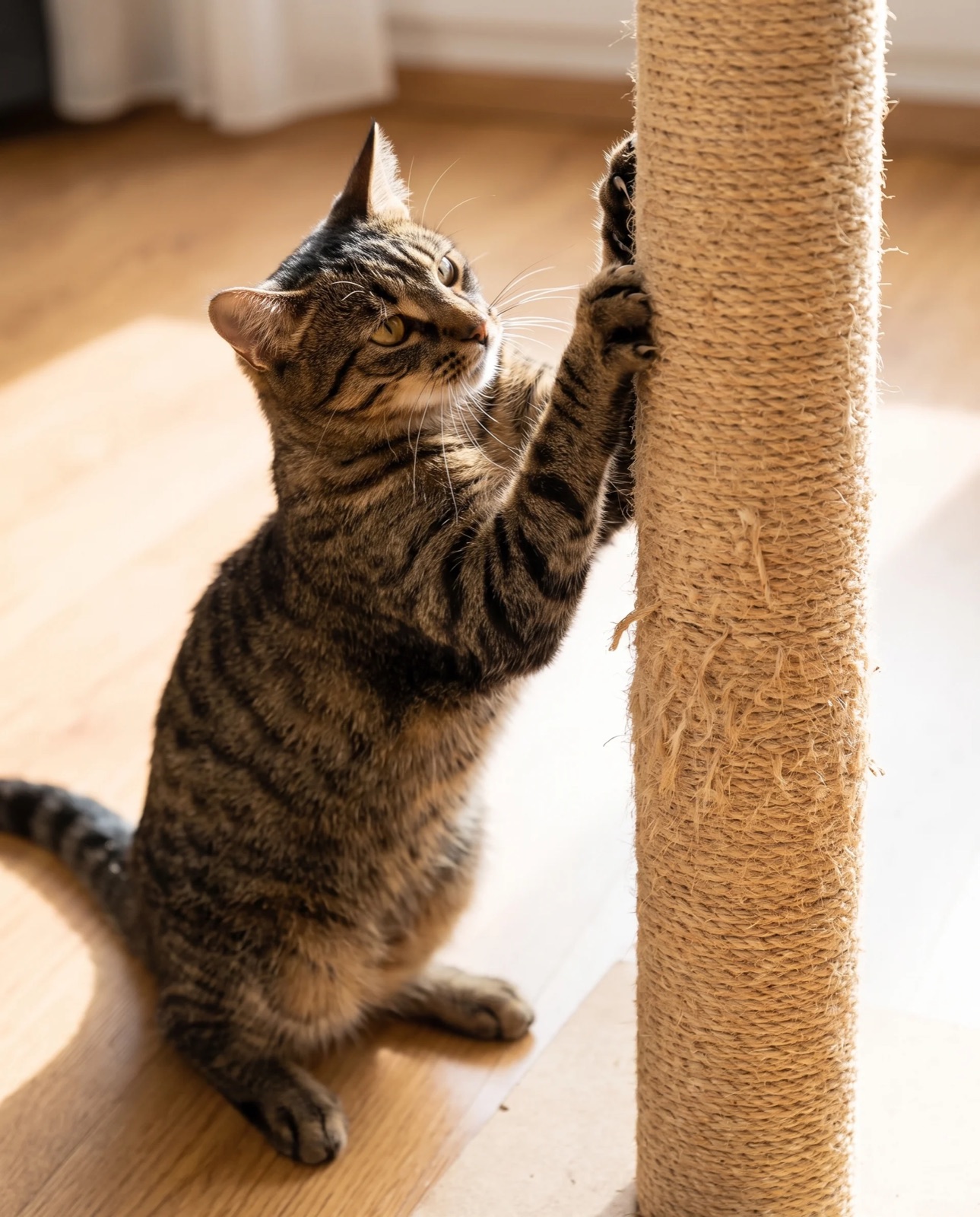
"The sofa? It was like that when I got here."
The scratching rebel has one great passion: scratching. The sofa, the wallpaper, the door frame or that expensive rug you just bought. Nothing is safe from his claws. Yet he doesn't do it to annoy you. Scratching is natural behaviour for every cat; in the scratching rebel it's simply turned up to maximum.
So why do cats scratch? It keeps their claws in top condition, as the old outer layer wears away. It stretches their muscles, from their toes to their back. And it leaves their signature: through scent glands in their paws, they tell everyone 'this is mine'. So scratching isn't just grooming, it's communication too. And the scratching rebel has a lot to say.
How to recognise the scratching rebel
- Scratching is the first thing he does after waking up.
- He has one or two favourite scratching spots and keeps going back to them.
- He scratches both standing up at full length and lying flat on the floor.
- He scratches extra enthusiastically when he's happy, excited or tense, for example when you come home or when you have visitors.
- Your furniture tells his story better than we ever could.
What does the scratching rebel need?
A better alternative to your furniture. A scratching rebel will never stop scratching, and he shouldn't. The trick is to give him a spot that feels even better to scratch than the sofa. That means: sturdy, tall enough to stretch out fully, and right where he already scratches.
Forbidding it doesn't work. What does work is placing the scratching post right next to his favourite scratching spot and rewarding him when he makes the right choice. Rub a little catnip on the sisal, play with a teaser wand around the post and give him a treat or some praise as soon as he digs his claws in. He'll quickly learn where the real scratching spot is.
The ideal scratching post for the scratching rebel
- Lots of sisal, and we really do mean lots. Thick posts he can really feel in his claws.
- Long scratching posts he can stretch against at full length.
- A heavy, wide baseboard he'll ignore a scratching post that wobbles.
- Horizontal scratching options, such as a scratching board, scratching mat or scratching cardboard, for cats who also like to scratch lying down.
Rebel tip: does your scratching rebel have several favourite spots? Then put something to scratch at every one of them. The easier the alternative, the sooner your sofa is yours again.
The indoor rebel: there's plenty going on inside.
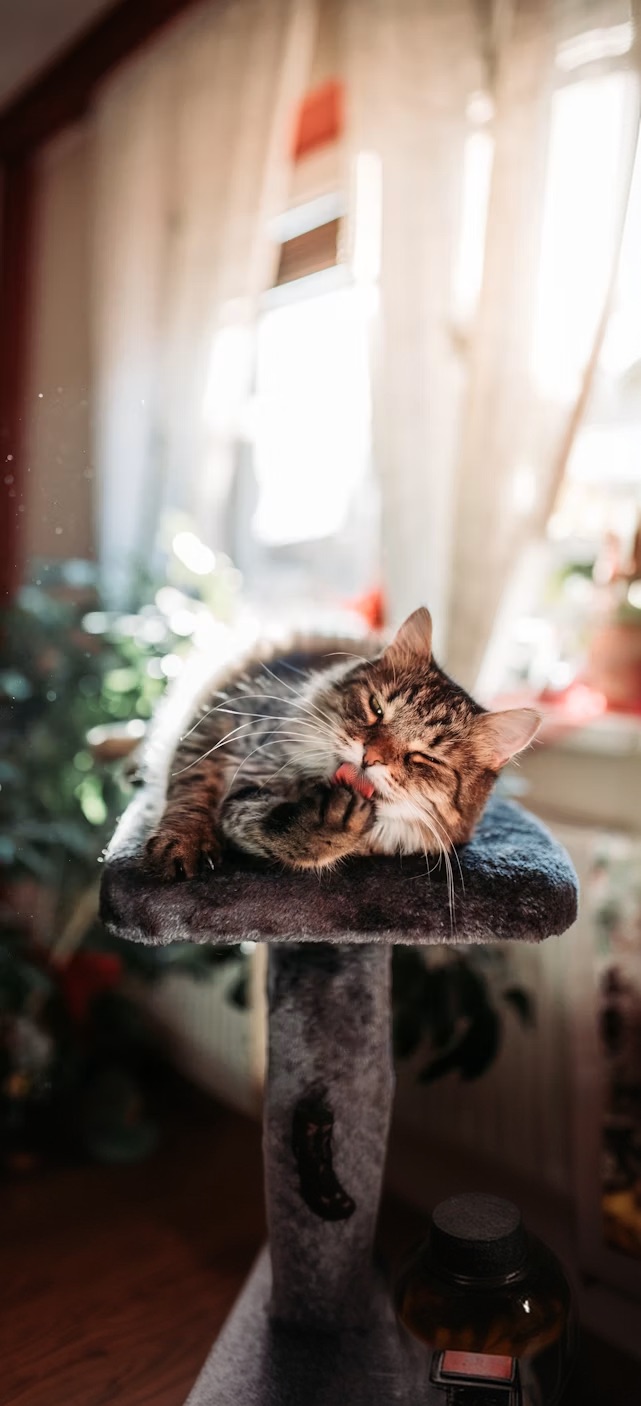
"Outside? I've got everything I need right here."
The indoor rebel lives indoors and is perfectly happy with that. His world is your home, and he explores every last corner of it. He knows exactly which cupboard has the best view, which windowsill offers the most birds and what time you fill his bowl. Whether he lives in a city apartment or simply prefers to stay in: the indoor rebel turns his home into his own jungle.
Because he doesn't go outside, he misses out on the stimulation an outdoor cat gets automatically: trees to climb, sounds to investigate and prey to hunt. All that energy has to go somewhere. If an indoor rebel doesn't get enough of a challenge, he'll go looking for one himself. Think racing down the hallway at three in the morning, discovering the plant pot or scaling your bookcase.
How to recognise the indoor rebel
- He spends hours on the windowsill keeping an eye on the outside world.
- He chatters his jaw when a bird flies past.
- He seeks out high places, like the cupboard, the fridge or the top shelf.
- He regularly has his 'crazy five minutes' and sprints through the whole house.
- He follows you around the house wanting to know what you're doing, because you're his biggest adventure.
- New boxes, bags and parcels are inspected immediately.
What does the indoor rebel need?
Challenge, exercise and height. An indoor rebel needs a home that gives him plenty to do. Cats don't just live on the ground, they live up high too. By adding extra vertical space, his territory suddenly becomes much bigger, without you having to move house.
On top of that, play is essential for the indoor rebel. Plan a few short play sessions every day with a teaser wand or a ball that moves like prey. Hide a treat on a high platform now and then, or move his toys around, so there's always something new to discover. And don't forget the view: a spot by the window is cat TV for him.
The ideal scratching post for the indoor rebel
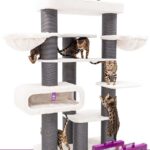
- Tall with multiple levels, so he can climb, jump and follow his own route.
- A spacious lookout platform at the top, ideally by the window.
- Play elements like dangling toys, tunnels and caves to jump in and out of.
- A cosy lounge box or hammock to recover in after all that adventure.
- A solid construction, because an indoor rebel launches himself at it at full speed.
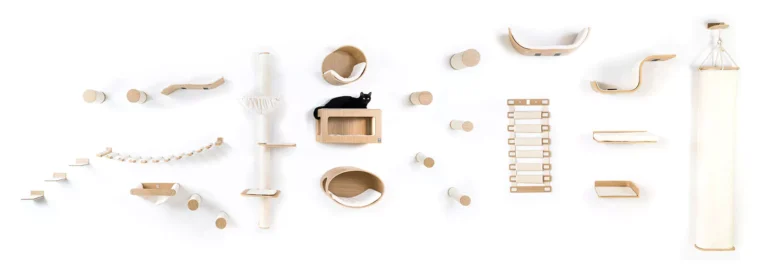
- Combine with wall elements to create a complete climbing route around the room.
Rebel tip: does your indoor rebel live in a smaller home? Then go up. A tall, slim scratching post or a climbing wall takes up little floor space but gives your cat a whole new playground. Time to sit back and watch the world from up high....
The outdoor rebel: the neighbourhood is his kingdom.
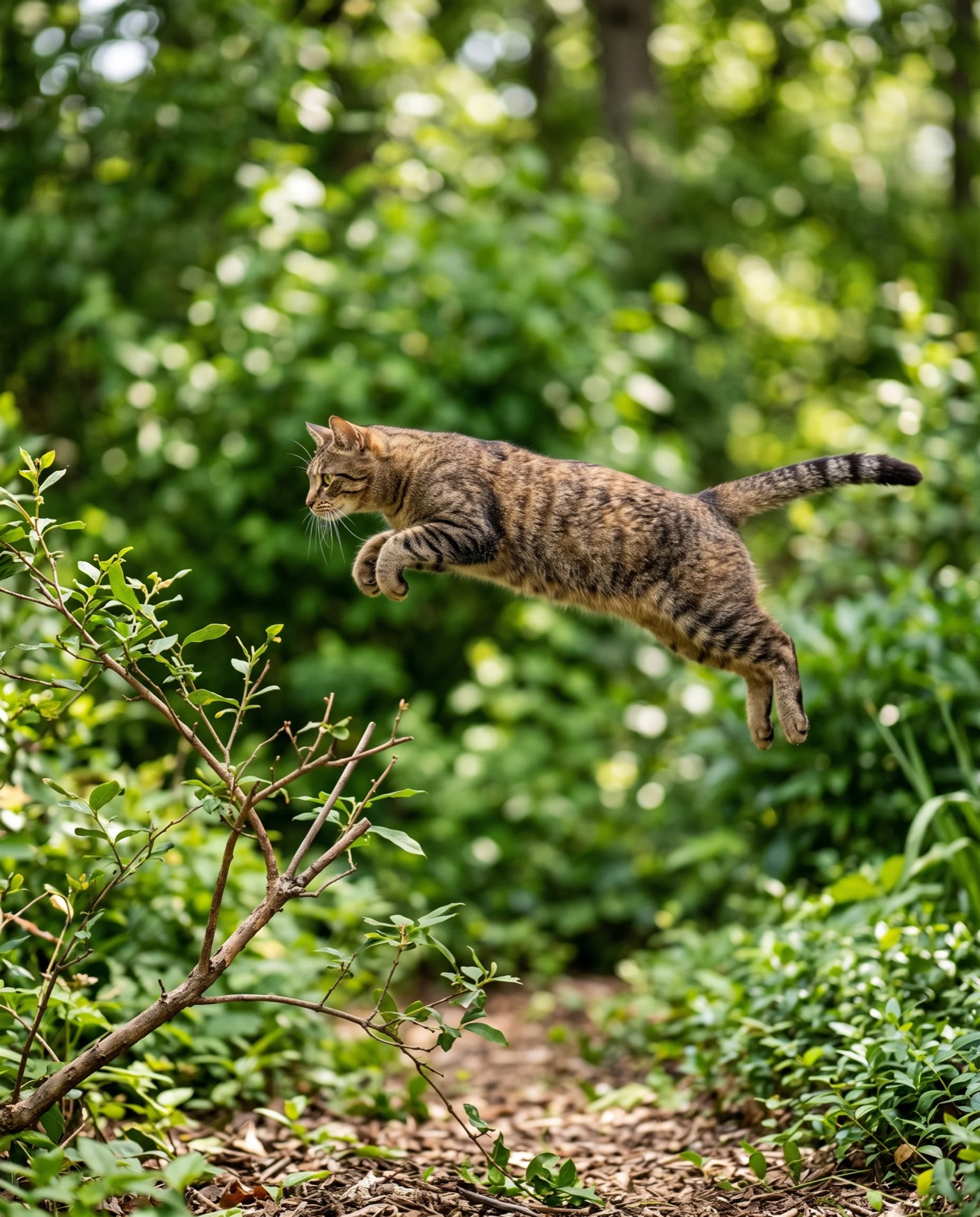
"I'm off. When will I be back? You'll see."
The outdoor rebel is a true adventurer. As soon as the cat flap opens, he's gone: into the garden, over the The outdoor rebel is a true adventurer. As soon as the cat flap opens, he's gone: into the garden, over the fence and through the neighbourhood. He knows every bush, every neighbourhood cat and probably every neighbour who slips him a treat on the sly. Outside he's free, bold and independent. He's the Rebel most like his wild ancestors.
But even the toughest outdoor rebel comes home eventually. Wet from the rain, tired from hunting or simply ready for a warm spot. And then he wants a place indoors that's all his own. Because even though he lives half his life outside, his home base is and always will be with you.
How to recognise the outdoor rebel
- He's waiting at the door or cat flap as soon as he wakes up.
- He comes home with leaves in his fur and sometimes a 'present' for you.
- He's independent and decides for himself when he wants attention.
- Indoors, he often sleeps deeply and for a long time to recover from his adventures.
- Outside he scratches trees and fences, but indoors he also likes to mark his territory.
- In bad weather or in winter he's suddenly indoors a lot more, and that's when he does want to be entertained.
What does the outdoor rebel need?
A safe, comfortable home base. Outside, an outdoor rebel always has to be alert: for other cats, dogs, traffic and loud noises. Indoors, he wants to switch off completely. A warm, sheltered spot where he can sleep undisturbed is no luxury for him, it's a must.
Don't forget that scratching is just as important indoors as it is outside for this cat. By scratching, he leaves his scent and says: 'this house is mine'. If he doesn't have a good scratching spot indoors, he'll pick one himself, and it's often not the one you'd hoped for. In autumn and winter too, when he spends more time indoors, he needs somewhere to burn off energy.
The ideal scratching post for the outdoor rebel
- A cosy lounge sofa or box to curl up in, safe and warm, after a day outdoors.
- Soft plush and thick cushions for those long, deep sleeps.
- Sturdy sisal posts so he can use his claws and leave his scent indoors too.
- A lookout platform, ideally by the window, so he can keep an eye on his outdoor territory from inside.
- A robust, stable build to match a tough, strong cat.
Rebel tip: place your outdoor rebel's scratching post along your cat's usual route (your cat always takes the same path from the living room to the kitchen). That way it's the first place he passes when he comes home, for a quick scratch, to leave his scent and then settle in for a good sleep.
Good to know
My cat fits more than one character
That's the rule rather than the exception. Many cats are a mix: an indoor rebel who turns into a lazy rebel in the afternoon, or an outdoor rebel with a strong scratching rebel side. Look mainly at what your cat does most and which spots it already chooses. Torn between two Rebels? Then choose a scratching post that combines both worlds.
Character or breed?
Some breeds have a well-known reputation. A Ragdoll or British Shorthair is known for being calm, while a Bengal or Abyssinian is often full of energy. But in the end, every cat is unique: even a Ragdoll can be a real scratching rebel. With large breeds like the Maine Coon, do keep size in mind. They need extra-wide lying areas, hammocks and a heavy, stable base.
Characters change over time
A kitten is almost always an indoor rebel and a scratching rebel at the same time: everything is new and everything needs scratching. As a cat gets older, its character often shifts towards the lazy rebel. The seasons play a part too: an outdoor rebel often spends more time indoors in winter and suddenly feels more like climbing and playing. So check every now and then whether the scratching post still suits who your cat is now.
Still not sure? Come and visit!
Recognise your cat but not sure which scratching post suits it best? Our scratching post experts are happy to help. Visit our showroom in Schijndel, where you can see, feel and test the entire collection. We know everything about cats, their characters and which scratching post makes them happiest.
And is your Rebel over the moon with his new scratching post? Share a photo and claim your spot on our Wall of Fame. Because every Rebel deserves a stage
Frequently Asked Question
Take a look at what your cat loves doing most. Sleeping for hours on end? Scratching everything in sight? Racing around the house or going on patrol outside? Their daily habits will tell you what sort of rebel you’ve got at home.
Absolutely! An Indoor Rebel can also be a keen scratcher. And an Outdoor Rebel can turn out to be the biggest sleepyhead at home. Choose a scratching post that suits the combination of their favourite activities.
A Lazy Rebel loves soft baskets and hammocks. A Scratching Rebel likes long sisal posts to stretch out on. For an Indoor Rebel, climbing routes and play areas are ideal. An Outdoor Rebel can enjoy a good scratch at home and relax in a cosy spot.
Also consider your cat’s size, weight and age. A large Rebel needs spacious resting areas and a sturdy base. For kittens and older cats, easily accessible platforms are ideal. The scratching post should suit what your cat likes to do and can handle.
Go for plenty of space and variety: multiple resting spots, scratching posts and different heights. That way, one rebel can sleep whilst the other sharpens its claws. A favourite spot for every cat - that saves a lot of hassle!